A favourable judgment leaves the payment obstacle unresolved
The creditor obtained a favourable judgment in a construction contract dispute but remained unpaid. The debtor company had no funds in its accounts and also faced claims from other businesses and contractors. Recognition of the debt had not removed the practical obstacle to collecting it.
The company had undergone registration changes. Shanghai Shenxin Law Firm’s enforcement team therefore extended the inquiry beyond the immediate account position to the company’s history and financial activity. The relevant questions included whether registration developments and capital contribution issues supplied a further basis for examination. Corporate debt recovery can require asset investigation and liability-related inquiry to work together, with each directed by the particular records rather than by the result of a single balance check.
Define the investigation with the enforcement court
The team discussed the enforcement strategy with the court, applied for investigation orders and examined the company’s fund flows. The discussion focused on defined obstacles and questions to be answered. That gave the investigation a purpose beyond a general request for further enforcement activity.
Financial inquiry remains useful when an account currently holds no money. A present balance does not explain prior dealings or where funds have moved. In comparable matters, further investigation needs to be supported by available records and specific leads rather than an unlimited search. Here, counsel continued the financial work within the enforcement process while pursuing additional records that could clarify the company’s position and inform the choice of a further procedural route.
Review registration history and unpaid contribution issues
The internal company registration records revealed changes during enforcement and issues concerning unpaid capital contributions. Historical filings provided information about how the position had developed, beyond a current registration entry. They supplied a more concrete basis for examining a possible further claim.
Shareholder status or an unpaid contribution does not, by itself, answer every question about personal liability for a company debt. The analysis depends on the applicable rules, contribution circumstances and procedural requirements. In this matter, the registration leads were not treated as an already established liability finding. The team used the material to assess and pursue a further litigation route in which the relevant issues could be examined.
Pursue shareholder liability through a separate action
The team brought a separate action to pursue shareholder liability on the basis of the issues identified. This was a distinct step: investigation in the company enforcement matter supplied leads, while the additional litigation addressed whether another party should bear liability. The two strands were connected but were not the same procedural act.
That route requires a distinction between investigative findings, a claim advanced and an adjudicated liability. Shanghai Shenxin Law Firm’s team assessed the role of the different proceedings and extended the investigation into related litigation. This created a further route for advancing a debt that had been stalled at the company-account stage and brought the relevant questions of responsibility into a specific legal process.
Manage the transition from negotiation to withdrawal
As the additional action progressed, the relevant parties approached the creditor to discuss repayment and requested withdrawal. The question was then not merely whether acceptable terms could be discussed, but how the procedural steps would relate to the actual transfer of money. Willingness to engage was progress; completed performance required more.
In this case, the related action was withdrawn after the creditor received payment. The sequence placed actual performance before procedural closure rather than relying only on a promise. It illustrates an important part of recovery work: managing the transition from a contested claim to negotiation and then to performance, with the creditor’s receipt of funds remaining a concrete decision point throughout.
Document payment with a transfer record and the client’s acknowledgment
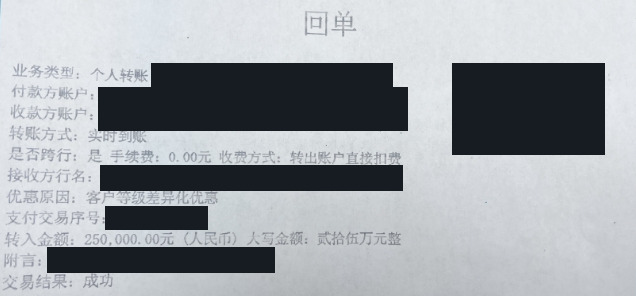
A bank transfer record in this matter shows a payment of RMB 250,000. In the accompanying communication, the client confirmed receipt of RMB 500,000 and agreed to withdrawal of the action. These materials show an individual transfer and the client’s acknowledgment of receipts respectively. They document actual performance beyond an expression of willingness to pay.
Several connected tasks contributed to that progress. Investigation extended beyond an account balance; company records supplied a further liability-related lead; a separate action helped bring the parties into repayment discussions; and the timing of withdrawal kept performance central. The creditor’s progress was money received. The professional contribution was to carry the necessary work through its successive stages and assess its effect against the performance actually achieved.
 View larger image (new tab) ↗
 View larger image (new tab) ↗
Look at both assets and the basis for responsibility
Shanghai Shenxin Law Firm’s enforcement team examines corporate debts in mainland China through both asset information and supported questions of responsibility. The work asks what a company presently holds and whether the records justify further examination of another party’s potential obligations. It requires reading financial and registration material together while understanding the distinct purposes of the available procedures.
This case illustrates one route forward from an empty company account, not a result applicable to every corporate debt. For a comparable construction receivable, the judgment, enforcement history, company filings and existing financial leads are useful starting materials. They allow the next step to be defined as a supported task instead of an assumption about what a shareholder must pay.
These case notes are anonymised. Individual outcomes depend on the facts, available assets and applicable procedures; past results do not guarantee future recovery.